Every year, thousands of students in Ranchi and across India sit for campus placement with the same hope — a good job before they leave college. But walk into any placement cell and you will hear the same story. Companies come, take a few students, and go back mostly empty handed. Not because there is no talent, but because there is a big difference between having a degree and being job ready.
The Real Problem: Degrees Are Many, Ready Candidates Are Few
Here is the problem I see every placement season. Companies want to hire freshers because they are energetic and cost less. Colleges want good placement numbers because that is how they attract new admissions. Students want jobs because that is the whole point of the course. Everyone wants the same thing, yet the match does not happen.
The reason is simple. Most students prepare only for the written test and a little bit of interview. They spend months memorising theory, but they have never built one real project, never used Git, and never spoken about their own work with confidence. So in the interview, even a simple question like “show me something you have built” becomes a problem.
So the gap is not “skills vs no skills”. The gap is exam skills vs job skills. Companies have openings and budget. Students have marks and certificates. But very few can actually do the work from day one.
Why This Matters for You
This matters because campus placement is often your easiest door into a good career. Once you leave college, you enter the open market where you compete with lakhs of other candidates, many with two or three years of experience. The campus round is your best chance to get hired while the competition is still small.
It matters even more because companies today do not train freshers from zero. A student with one solid project and clear speaking skills gets picked over a topper who has only marks on the sheet. That difference decides your first salary, your city and your growth for the next few years.
The Skills and Solutions That Actually Work
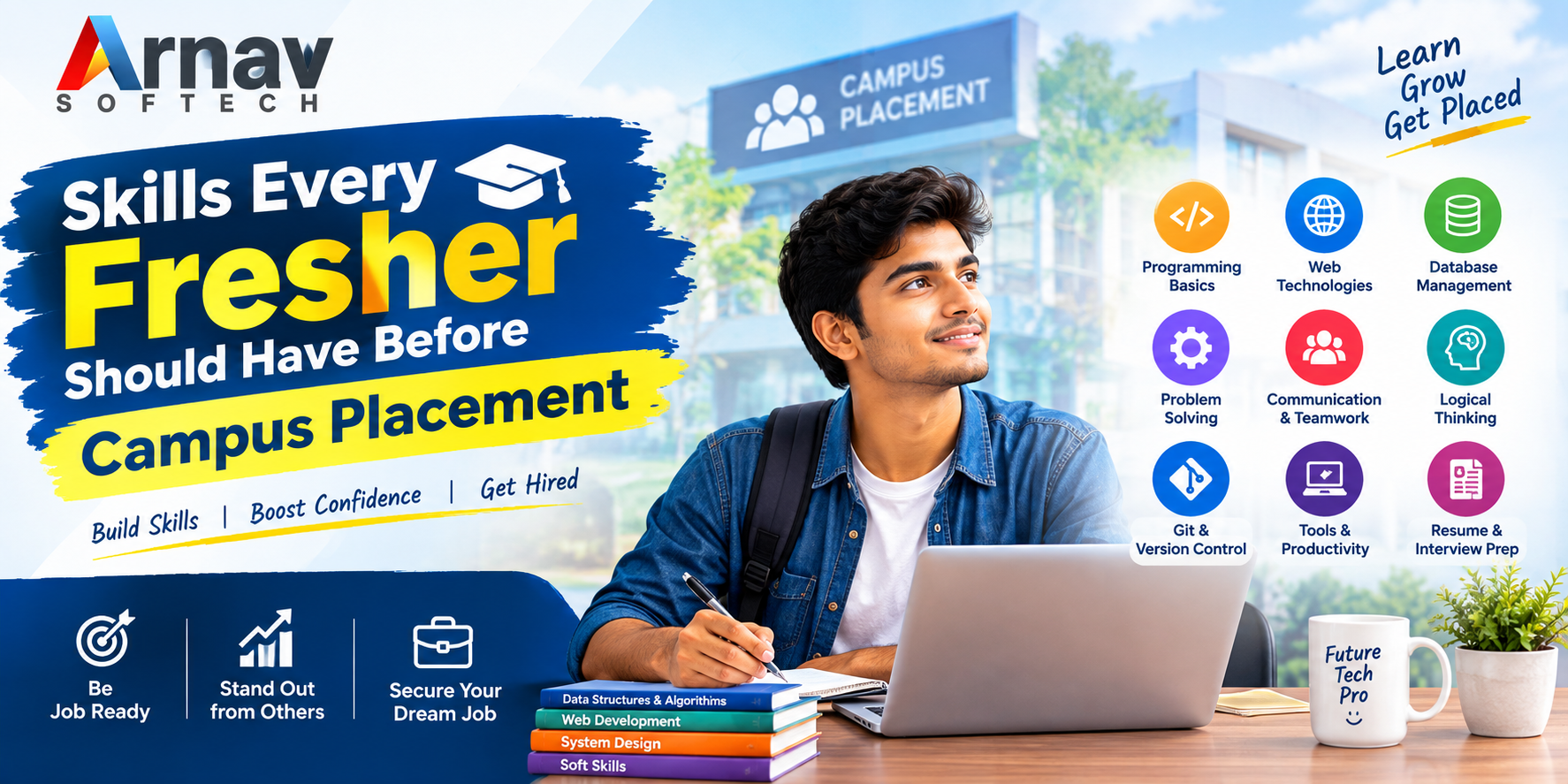
Now let us talk about solutions. Instead of doing ten random things, focus on a small set of skills that interviewers actually check.
- One strong programming language — Be comfortable in C, Java or Python. Not just syntax, but writing small programs on your own.
- Data Structures and basic Algorithms — The most asked topic in written tests and technical rounds. Arrays, strings, sorting and searching are enough to start.
- Basic database and SQL — Every company stores data. Knowing simple SELECT, JOIN and WHERE queries puts you ahead of many freshers.
- Real projects on GitHub — Two working projects say more about you than twenty certificates.
- Communication and confidence — Being able to explain your project clearly in simple English is a skill by itself.
- Aptitude and reasoning practice — The first round is usually a written test. Practice it regularly, it is easy marks.
- Resume and LinkedIn basics — A clean one page resume and a filled profile get noticed faster.
Comparing the Common Paths to Get Ready
Students usually prepare in one of three ways. See which one fits you.
My honest suggestion: don’t mix everything in a random way. A student who finishes one proper training path with two real projects is picked much faster than one who half watched fifty videos.
A Real Example from Our Own Students
At Arnav Softech, a BCA student once came to us a few months before campus placement. His marks were fine, but in the mock interview he could not explain a single project. He had only done theory throughout college.
So we did three simple things with him. First, he picked one language and practised small programs daily. Second, he built two real projects — a simple college website and a small result management tool for a coaching centre. Third, we made him sit in weekly mock interviews until he could speak comfortably about his work.
He cleared the first written round easily because he had practised aptitude. In the technical round he explained his project line by line, and the interviewer was clearly happy that he had actually built something. He got selected in the very first company that visited his campus. Nothing here was extraordinary — he just covered the right basics instead of running after fancy buzzwords.
Best Practices I Would Recommend
After training many students for placement, these are the habits that work:
- Start early. Begin at least six to eight months before placement, not one month before.
- Build projects, not just certificates. Two working projects with clean code are worth far more.
- Practise aptitude daily. Fifteen minutes a day is enough and it decides the first round.
- Learn basic Git and GitHub. Every company expects you to know it now.
- Do mock interviews. Speaking to someone a few times removes half your fear.
- Keep your resume to one page. Simple, clear and honest beats long and fancy.
- Stay consistent. One hour every day for six months beats ten hours once a week.
A Simple Placement Roadmap for Students
If you are a student reading this, here is a practical route:
- Step 1: Pick one language and master the basics with daily practice.
- Step 2: Learn data structures, arrays, strings and simple algorithms.
- Step 3: Get comfortable with SQL and basic database concepts.
- Step 4: Build two real projects and upload them on GitHub.
- Step 5: Practise aptitude, reasoning and spoken English regularly.
- Step 6: Prepare your resume, attend mock interviews and start applying.
This roadmap takes four to six months of honest work. Do it along with your studies and you will walk into your campus interview better prepared than most of your batch.
Final Words
Campus placement is not about being the smartest student in the room. It is about being the most prepared one. Companies are not expecting a genius. They are just looking for a fresher who knows the basics, has built something real and can talk about it clearly. The good news is that all of this can be learnt with proper training and regular practice. You do not need to do everything — just start with the right skills, stay consistent, and your first job will find you in time.
Get Placement Ready with Arnav Softech
Join our practical, job-oriented courses in Ranchi. Learn programming, data structures, web development and databases with live projects, mock interviews and guidance from senior developers — exactly what campus placement asks for.
Explore Our Courses & Batches →
Online & Offline batches available | Enroll today and start your journey