You opened YouTube, searched “best programming language to learn,” and got ten different answers — Python, Java, C++, JavaScript, PHP, and more. One week you start Python, next week someone says Java is better, and after a month you feel stuck without finishing anything. If this sounds like your story, the real problem is not that you are slow. The problem is that nobody told you how to pick your first language based on your goal.
The Business Problem: Too Many Options, No Clear Direction
Every year, thousands of students in Ranchi and across India want to enter the IT field. They join random online videos, copy code from tutorials, and still cannot build a proper project. Colleges teach theory, but jobs need practical skills like websites, apps, databases, and problem solving.
Common mistakes beginners make when choosing a first language:
- Following trends blindly — picking a language because it is popular on social media, not because it fits their career goal.
- Learning multiple languages at once — starting Python, Java, and C++ together and getting confused.
- Ignoring job market needs — learning a language with no local job demand in their city.
- No project practice — watching videos but never building a live website or app.
- Wrong advice from non-experts — friends and relatives suggest languages without knowing IT industry requirements.
Why Choosing the Right First Language Matters
Your first programming language shapes how you think about logic, data, and software design. If you choose well, you build confidence fast. If you choose randomly, you may quit before seeing results.
In 2026, companies in Ranchi and across India hire developers for websites, mobile apps, backend systems, and custom software. The language you learn first should connect directly to these job roles — not just look good on a certificate.
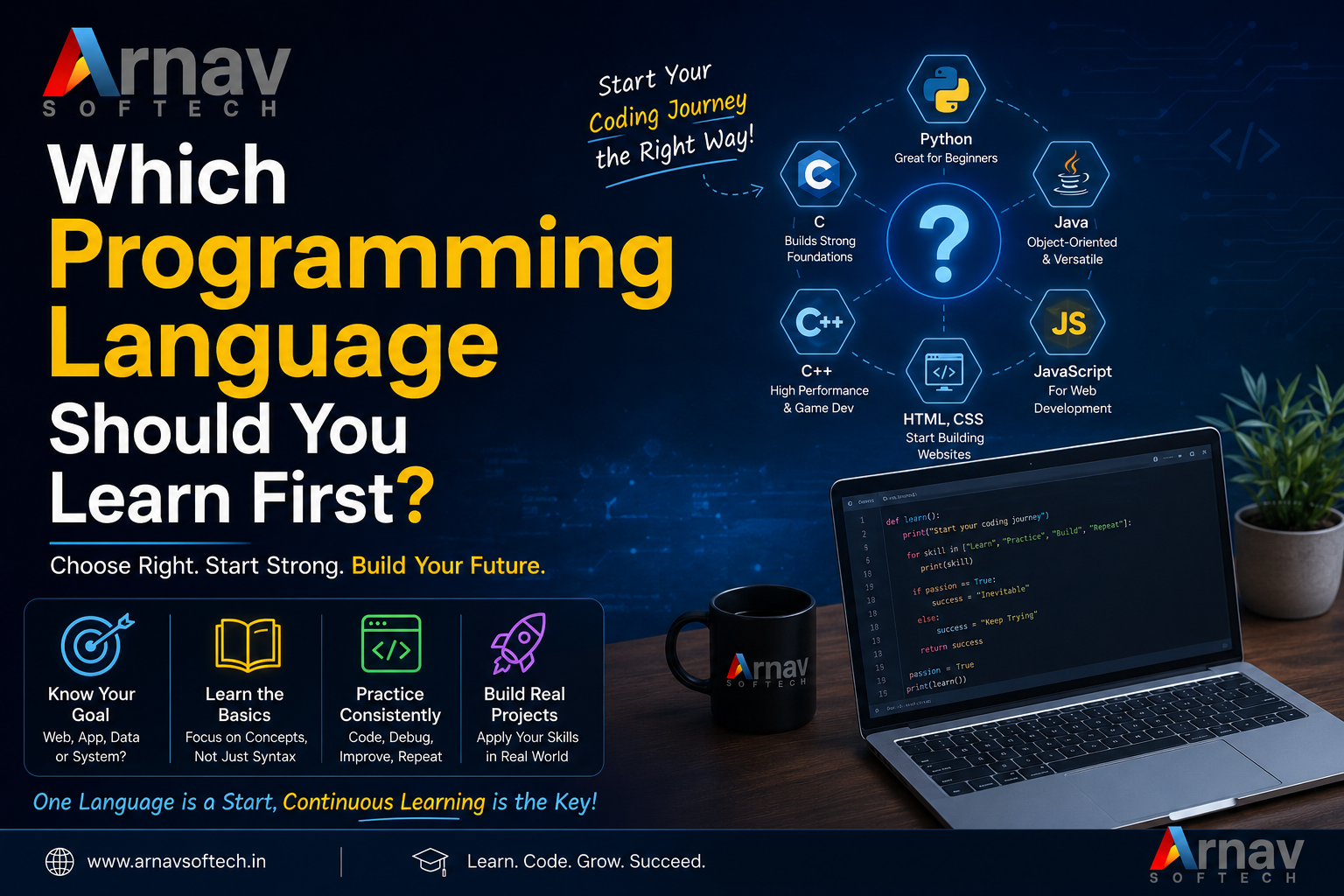
Popular First Languages — And Who They Are Best For
1. HTML & CSS (Start Here for Web Design)
Not full programming languages, but essential for anyone who wants to build websites. Easy to learn, visual results quickly, and a strong base before JavaScript or PHP.
2. JavaScript
Best for web development, frontend interfaces, and modern full-stack apps. High demand in startups and software companies. Works with React, Node.js, and React Native.
3. Python
Simple syntax, good for beginners, data analysis, automation, and Django web projects. Popular in colleges and growing in AI-related fields.
4. PHP
Still widely used for business websites, WordPress, and backend systems in India. Many local companies and agencies need PHP developers.
5. C / C++
Strong for logic building, college syllabus (BCA/MCA/B.Tech), and understanding how computers work at a deeper level. Helps with interviews and data structures.
6. Java
Common in college courses and enterprise software. Useful for Android basics in some institutes, but many modern Android jobs now prefer React Native with JavaScript.
Quick Comparison: Which Language for Which Goal?
| Your Goal | Best First Choice | Why |
|---|---|---|
| Website Developer | HTML → CSS → JavaScript → PHP | Most local web jobs need this stack |
| Mobile App Developer | JavaScript → React Native | Build Android apps without Java/Kotlin |
| College Student (BCA/MCA) | C++ or Java | Matches university syllabus & exams |
| Data / AI Interest | Python | Simple start, strong in data & automation |
| Complete Beginner (Age 18+) | HTML/CSS then JavaScript | Easy visual results build confidence |
Best Practices Before You Start Learning
- Pick one path, not five languages. Finish one language properly before jumping to the next.
- Match language to your career goal. Job-ready web developer? Start with web technologies. College exams? Follow your syllabus first.
- Learn by building projects. A small portfolio website or login app teaches more than 50 hours of theory videos.
- Practice logic daily. 30 minutes of coding problems helps every language — C, Java, Python, or JavaScript.
- Get mentor feedback. A trainer can correct your mistakes early and save months of confusion.
- Check local job posts. Search “web developer Ranchi” or “PHP developer Ranchi” to see what companies actually need.
Real Example: Two Students, Two Different First Languages
Two BCA students from Ranchi joined our training center with the same question — “Which language should I learn first?”
Student A wanted a web developer job in 6 months. We started him with HTML, CSS, JavaScript, and PHP. He built a business website, a login system, and a small admin panel. Within five months, he was confident enough to apply for junior web developer roles.
Student B needed to pass college exams and also wanted app development skills. He started with C++ for university syllabus, then moved to JavaScript and React Native for Android apps. He cleared college practicals and had two portfolio projects for interviews.
Both succeeded — but only because they chose a first language based on their goal, not on what was trending on Instagram.
Our Honest Recommendation
If you are completely new and want a job in IT, start with HTML, CSS, and JavaScript. These are the foundation of the web — and most beginners see real progress within weeks. After that, add PHP or Python based on your interest.
If you are a BCA/MCA student, learn your college syllabus language (C++, Java, or Python) alongside one job-oriented skill like web development. Do not wait until graduation to start practical training.
There is no single “best” language for everyone. The best first language is the one that matches your goal, your time, and the jobs available in your city.
Not Sure Which Course to Start With?
Arnav Softech offers structured programming courses in Ranchi — C/C++, Java, Python, Web Development, React Native, and more. Join a 3 Days FREE Demo Class and get personal guidance on which language fits your goal.