Picture a busy Saturday evening at your restaurant. Orders are piling up, the kitchen is running behind, and your
cashier is manually writing bills on a register pad while customers wait at the counter. A wrong item gets added, a
discount is forgotten, and by the time the bill is corrected, the table has already left unhappy. If this sounds
familiar, you are not alone — and the root cause often lies in the billing system itself.
The Business Problem: When Billing Becomes a Bottleneck
Traditional billing systems — manual cash registers, handwritten KOT (Kitchen Order Tickets), and calculator-based
invoicing — were designed for a simpler era. Today, restaurants handle dine-in, takeaway, delivery aggregator
orders, split bills, combo offers, and GST-compliant invoices all at once. When billing is disconnected from
inventory, kitchen operations, and customer data, errors multiply and revenue quietly leaks away.
Common pain points restaurant owners face with traditional billing include:
- Slow order-to-bill cycle — staff re-enter items manually,
increasing wait times during peak hours. - Billing mistakes — wrong quantities, missed add-ons, and
incorrect tax calculations lead to disputes and refunds. - No real-time inventory sync — you sell items that are already out
of stock because billing and stock are not linked. - Limited reporting — you see total sales, not which dishes or hours actually drive profit.
- Poor customer experience — long queues, no digital payment
options, and no order history for repeat guests.
Why This Matters More Than Ever
In India’s competitive food service market, margins are thin and customer expectations are high. A single bad
billing experience can cost you a loyal diner and a negative online review. Meanwhile, food delivery platforms, UPI
payments, and GST compliance have made restaurant operations far more complex than a simple cash counter can handle.
Restaurants on traditional billing often spot problems only at month-end — during cash reconciliation or inventory checks. By then, revenue has already leaked. Modern billing is the nerve centre of your restaurant, not just a receipt printer.
Possible Solutions for Restaurant Billing
If you are evaluating a billing upgrade, you generally have three paths to consider:
1. Traditional Billing (Cash Register + Manual KOT)
The lowest upfront cost option. Suitable only for very small outlets with a limited menu and low order volume. Works
until growth, delivery orders, or tax compliance requirements make manual processes unsustainable.
2. Basic Electronic Billing Machine
A step up from manual billing — generates printed bills with tax breakdowns. However, most basic billing machines do
not connect to your kitchen, inventory, or online delivery channels. You still manage operations separately.
3. Restaurant POS (Point of Sale) System
A complete software solution that handles order taking, KOT printing, billing, inventory management, table
management, staff roles, sales reports, and payment integrations — all from one platform. This is the option most
growing restaurants choose when they want to scale without adding chaos.
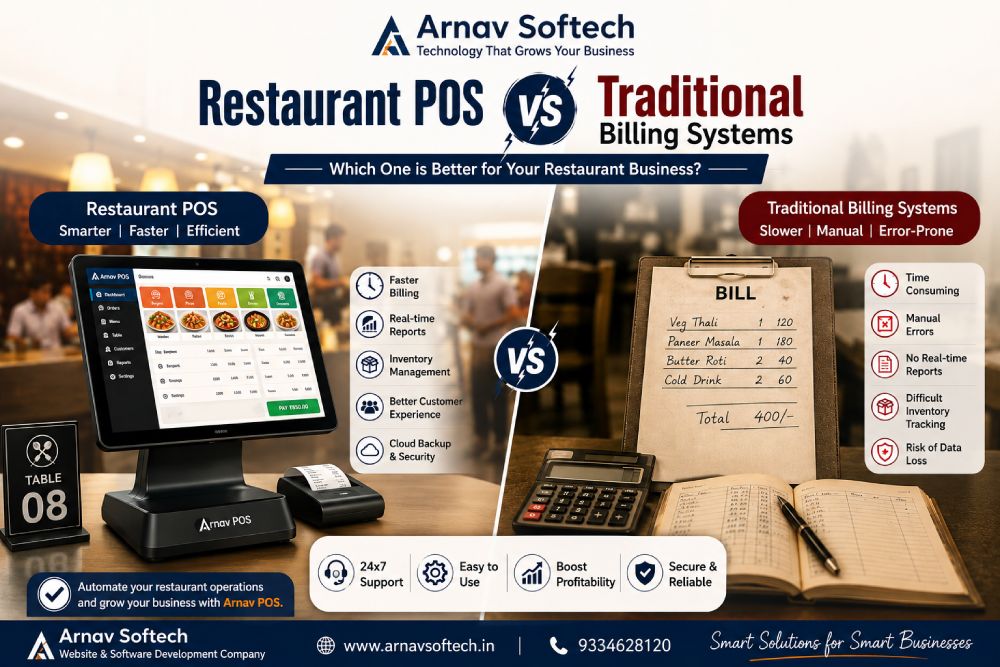
Restaurant POS vs Traditional Billing: Side-by-Side Comparison
| Feature | Traditional Billing | Restaurant POS |
|---|---|---|
| Order Speed | Slow — manual entry at every step | Fast — tap-to-order with auto KOT |
| Billing Accuracy | Prone to human error | Automated tax, discounts & splits |
| Inventory Tracking | Manual stock checks | Real-time deduction on each sale |
| Kitchen Communication | Paper KOT or verbal orders | Digital KOT to kitchen display |
| Sales Reports | End-of-day totals only | Hourly, item-wise, staff-wise analytics |
| Payments & GST | Cash only, manual tax calculation | UPI, cards, auto GST invoices |
| Scalability | Breaks down with growth | Supports multiple outlets |
The upfront cost of a POS system is higher than a cash register, but the return on investment becomes clear within
weeks — fewer billing errors, faster table turnover, better inventory control, and data-driven menu decisions.
Best Practices When Choosing a Restaurant POS
Not every POS system is built the same. Before you invest, keep these best practices in mind:
- Match features to your restaurant type. A fine-dine restaurant
needs table management and course-wise KOT. A QSR needs speed billing and combo meal support. Choose accordingly. - Ensure GST-ready invoicing. Your POS should generate
GST-compliant bills with HSN codes, CGST/SGST breakdown, and exportable reports for filing. - Prioritise ease of use. If your staff needs weeks of training,
the system will slow you down instead of helping. Look for intuitive interfaces that new hires can learn in a day. - Integrate delivery and payments. Your POS should handle Swiggy/Zomato orders, UPI, and cards from one dashboard — with offline billing when the internet drops.
- Plan for local support. Choose a provider who offers setup, training, and responsive support in your region.
Real-World Example: How a Cafe in Ranchi Transformed Operations
Consider a mid-sized cafe in Ranchi running on a cash register and handwritten KOT slips. Lunch rush billing took over eight minutes per table, kitchen errors were frequent, and the owner had no idea which menu items were profitable.
After switching to a restaurant POS system, the cafe saw immediate improvements:
- Billing time dropped to under two minutes per table.
- Kitchen errors reduced by nearly 70% thanks to digital KOT printing.
- Daily sales reports revealed that three low-margin items were consuming prep time
— they were replaced with higher-margin alternatives. - UPI and card payments increased by 40% because customers could pay directly at the
table.
Within three months, the cafe reported a 15% increase in daily revenue — not from raising prices, but from faster
service, fewer errors, and smarter menu decisions driven by POS data.
The Verdict: POS Wins for Any Restaurant Planning to Grow
Traditional billing worked when restaurants were simpler. In 2026, with delivery apps, UPI, and GST compliance, a restaurant POS is an operational necessity — the real question is which system fits your menu and growth plans.
List your daily pain points, demo two or three systems, and involve your staff in the decision. The right POS should feel like a reliable team member who never makes billing mistakes.
Ready to Upgrade Your Restaurant Billing?
Arnav Softech offers custom restaurant management software with POS billing, kitchen order management, inventory
tracking, and GST-compliant invoicing — built for restaurants, cafes, and food businesses across India.