
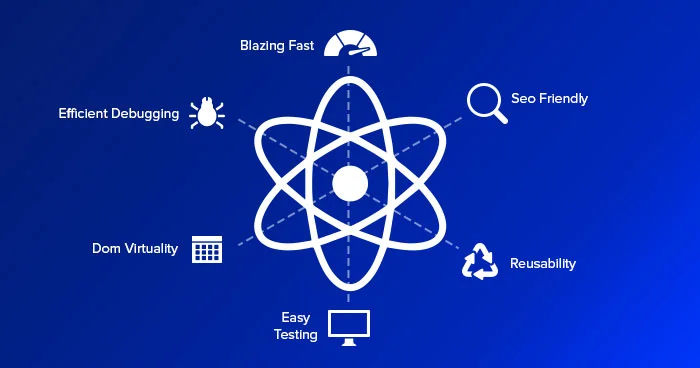
React JS: Why ReactJS is My Favourite Coding Language?
In the fast-moving universe of frontend web development, technologies come and go. A framework that is hailed as revolutionary today can become deprecated tomorrow. Yet, amidst this rapid churn, one technology has not only stood the test of time but has grown to dominate the web: ReactJS.
Often, developers refer to React as their favourite “coding language.” While purists will quickly point out that React is technically an open-source JavaScript library rather than a programming language, the distinction is practically academic. In practice, React has become the default syntax through which we express modern user interfaces. It has completely reshaped how we think, design, and write front-end code.
At Arnav Softech, we have built countless high-performance applications, and React remains our go-to solution. Whether you are looking for enterprise-grade applications or top-tier website design and development services, choosing the right tech stack is crucial. In this comprehensive guide, we will explore why ReactJS has captured the hearts of developers worldwide, its rich history, its core features, how it stacks up against competitors like Angular and Vue, and why hiring a skilled React JS Developer is the ultimate choice for your next project.
1. What is ReactJS? The History of React
At its core, ReactJS is a declarative, component-based, open-source JavaScript library used for building interactive user interfaces, specifically for single-page applications (SPAs). It handles the view layer of web and mobile applications, allowing developers to create reusable UI components that manage their own state.
The Origin Story
To understand why React is so powerful, we must look at the problem it was built to solve. In the early 2010s, Facebook (now Meta) was facing a massive scaling issue. As their user base exploded and features like the real-time News Feed and chat became more complex, updating the user interface efficiently became a nightmare. Traditional methods of manipulating the browser’s Document Object Model (DOM) were slow, buggy, and resource-intensive.
In 2011, Jordan Walke, a software engineer at Facebook, created a prototype called FaxJS. This prototype aimed to make UI updates faster and more predictable by rendering the UI every time data changed, using a virtual representation. This prototype was deployed on Facebook’s News Feed in 2011, and it immediately resolved major performance bottlenecks.
Recognizing its potential, Facebook acquired Instagram and implemented React in the Instagram feed in 2012. Finally, in May 2013, Facebook decided to open-source React at JSConf US. Initially, the developer community was skeptical, particularly about JSX (mixing HTML with JavaScript). However, as developers realized how fast and maintainable React applications were, skepticism turned into widespread adoption. Today, React is maintained by Meta and a massive community of individual developers and corporations.
2. Best Features of React JS: Why Developers Love It
React’s meteoric rise is direct proof of its stellar feature set. It solves the most annoying parts of frontend development with elegant, reusable abstractions. Here are the best features that make ReactJS a developer’s absolute favourite:
A. Component-Based Architecture
React allows you to break down a complex user interface into small, isolated, and reusable pieces of code called components. Think of them like LEGO blocks. You can build a Button, a Navbar, and a UserProfileCard, and then assemble them to create a complex web page. This modularity makes code easier to write, test, and maintain.
B. The Virtual DOM (Document Object Model)
When a user interacts with a standard web page, the browser updates the HTML DOM, which is slow and computationally expensive. React solves this by keeping a lightweight virtual representation of the DOM in memory. When a component’s state changes, React creates a new Virtual DOM tree, compares it with the previous tree (diffing), and updates only the specific elements that changed (reconciliation), boosting speed dramatically.
C. JSX (JavaScript XML)
JSX is a syntax extension that allows developers to write HTML-like markup directly inside JavaScript. Instead of separating the markup (HTML) from the logic (JavaScript) in different files, JSX brings them together in a clean, readable format, making UI creation highly intuitive.
D. Unidirectional Data Flow
React employs a one-way data binding structure. Data flows from parent components down to child components via props. Because data cannot flow backward, tracking bugs becomes infinitely easier since you always know exactly where a piece of state originated.
E. React Hooks
Introduced in React 16.8, Hooks revolutionized state management. With Hooks like useState and useEffect, developers can write lightweight functional components instead of heavy, complex class-based components, making codebases easier to understand and maintain.
3. React Compared with Other Frontend Tools: Vue JS and Angular JS
To truly appreciate React, it is helpful to see how it compares to other leading frontend tools: AngularJS (and its modern successor Angular) and Vue.js.
| Feature | React JS | Angular | Vue JS |
|---|---|---|---|
| Type | Library | Full Framework | Progressive Framework |
| Data Binding | One-Way (Unidirectional) | Two-Way (Bidirectional) | Two-Way (Bidirectional) |
| DOM Type | Virtual DOM | Real DOM | Virtual DOM |
| Learning Curve | Moderate | Steep | Gentle |
| Flexibility | High (Choose your tools) | Low (Opinionated structure) | Medium (Flexible yet styled) |
| Community Support | Exceptionally High | High | Moderate-to-High |
React vs. Angular: Angular is a full-fledged, highly opinionated framework maintained by Google. It comes with everything built-in (routing, HTTP clients, form validation). While this is great for large corporate teams that want strict structure, it makes Angular heavy and difficult to learn. React, being a lightweight library, lets you choose only the tools you need, offering unparalleled architectural freedom.
React vs. Vue JS: Vue is a progressive framework that has a gentle learning curve. However, Vue’s ecosystem is significantly smaller than React’s. For large-scale enterprise projects, React’s massive library support and battle-tested architecture make it a safer, more scalable choice.
“When a business hires a professional React JS Developer, they are tapping into a technology that offers the perfect sweet spot: the lightweight nature of Vue and the robust power of Angular, backed by the largest developer community in the world.”
4. Why React is the Most Popular Frontend “Language”
React isn’t just a developer favorite; it is the industry king. According to various developer surveys, React consistently ranks as the most widely used and loved frontend tool worldwide. Here is why:
-
✔
Massive Ecosystem & Reusability: Because React has been dominant for over a decade, its ecosystem is unmatched. From routing to data charts and animation libraries, everything you need is already built. Additionally, React Native lets you compile React code into native iOS and Android apps.
-
✔
Server-Side Rendering (SSR) & SEO: Historically, Single Page Apps struggled with SEO. React solved this by enabling Server-Side Rendering (SSR) and Static Site Generation (SSG) via advanced frameworks like Next.js, guaranteeing ultra-fast loads and excellent Google rankings.
-
✔
Unparalleled Career Demand: The market demand for a skilled React JS Developer is exceptionally massive. From modern startups to global giants like Netflix, Airbnb, and Uber, everyone uses React.
-
✔
Continuous Innovation: Meta continues to invest heavily in React. With recent features like React Server Components (RSC) and the highly anticipated React Compiler, the framework continues to redefine web standards.
5. How Arnav Softech Can Help You in Your React Development
Building a high-quality React application requires more than just knowing basic syntax. It demands architectural foresight, clean state management, and optimized rendering processes to ensure a premium user experience. That is where Arnav Softech comes in.
As a premier agency offering complete website design and development services, we help businesses translate their ideas into state-of-the-art web applications. Our services include:
- Dedicated React Experts: Work with an elite React JS Developer team that understands component optimization, custom hooks, and advanced state management.
- Custom Web App Development: From high-end SaaS dashboards to dynamic, fast-loading e-commerce platforms, we build secure, scalable React applications.
- Performance Optimization: We audit existing React code bases to eliminate unnecessary re-renders, optimize bundle sizes, and implement lazy loading to guarantee perfect Lighthouse scores.
- Legacy Migrations: If your web platforms are running on slow, outdated frameworks, we can migrate your frontend to React seamlessly without any downtime.
6. Conclusion: The Era of React is Here to Stay
ReactJS has earned its place as the world’s favorite frontend tool by focusing on developer experience, visual performance, and modularity. By redefining how we interact with the DOM and introducing the elegant paradigm of component-driven design, it has changed web development forever.
Whether you are a developer writing your first functional component or a business looking to build a modern web app, React is a choice you will never regret.
Ready to Elevate Your Digital Presence?
Partner with Arnav Softech to turn your web vision into a blazing-fast reality. Let’s design and build premium web applications that engage your users and drive growth.
Transform your website with our React expertise!
Author: Arnav Softech Editorial Team
Category: Technology, Web Design & Frontend Development
Date: May 17, 2026
Official Website: arnavsoftech.in